You open SSMS, click a database, and get this instead of your tables:
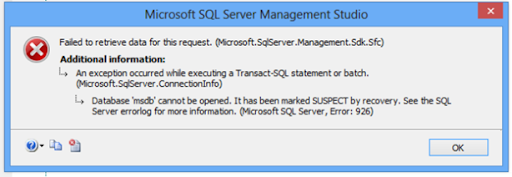
That is SQL Server Error 926. It tells you the database failed its recovery process, so the engine has put it in SUSPECT state and refuses to open it. Reads and writes stop until you intervene. This guide covers what triggers the error, how to diagnose it, and the recovery options in order of safety.
What Does SQL Server Error 926 Mean?
Every time SQL Server brings a database online, it runs recovery. It replays committed transactions from the log and rolls back the uncommitted ones, which leaves the data in a consistent state. If that process hits something it cannot get past, such as an unreadable page or a missing or damaged log, the engine stops and flags the database as suspect.
In Microsoft's documentation, Error 926 (MSSQLSERVER 926) uses the symbolic name DB_SUSPECT. It can appear when:
- an instance of SQL Server starts up,
- you attach a database, or
- you run RESTORE DATABASE or RESTORE LOG.
You will see the same error with an MSDB suspect error 926 (covered below) or after a restore, where it is often followed by Error 3414 ("an error occurred during recovery, preventing the database from restarting").
Common Causes of Error 926
The error is a symptom, so the real cause sits underneath it. The usual suspects are:
- Failing disks, controller issues, and torn pages are the most frequent reasons. Microsoft's own guidance is that persistent I/O errors or torn pages mean you should fix the hardware first, then restore from backup.
- Power loss or a server crash while transactions are in flight can leave files in an inconsistent state.
- Without a usable log, recovery cannot complete.
- Wrong permissions, a dismounted drive, or a path that changed.
- Not enough disk space or memory during startup or restore.
- The restore completes but the database cannot recover afterward.
- An upgrade script that cannot open msdb is a known trigger.
Step 1: Read the SQL Server Error Log First
Do not run any repair commands yet. Microsoft's guidance is to inspect the error log and find out why recovery failed. If the instance has restarted since, check the older logs too, because the original failure may only appear there.
Look for lines just before the 926 message. An operating system error (such as 23 or 5) points to disk or permission problems. A message about a torn page or checksum failure points to corruption. Confirm the state of the database as well:
Microsoft documents what each state means in Database States.
Step 2: Protect What You Have
Before any repair attempt, copy the MDF, NDF, and LDF files somewhere safe. Repair commands can remove data, and a copy gives you a way back. Microsoft's DBCC CHECKDB documentation also recommends making physical copies of the database files before running a repair.
One common mistake is detaching the suspect database. Don't do it. A suspect database often cannot be reattached without complicated workarounds.
Step 3: Fix Microsoft SQL Server Error 926 by Restoring From Backup
This is the method Microsoft itself recommends. If you have a clean full backup (plus differential and log backups), restore it. It is the only approach that does not risk data loss from a repair.
- RESTORE DATABASE YourDatabase
- FROM DISK = 'D:\Backups\YourDatabase_Full.bak'
- WITH NORECOVERY, REPLACE;
- RESTORE LOG YourDatabase
- FROM DISK = 'D:\Backups\YourDatabase_Log.trn'
- WITH RECOVERY;
Test the backup on another server if you can. If the restore itself ends in Error 926, the backup may be damaged, or the underlying disk is corrupting data. Try an earlier backup or a different storage target. For step-by-step options, see Microsoft's pages on restoring a database backup using SSMS and the RESTORE statement reference.
Step 4: Run DBCC CHECKDB to Assess the Damage
Should you run DBCC CHECKDB before restoring? If the database is accessible in emergency mode, yes. It tells you how bad the damage is and which repair level, if any, applies. Run it without a repair option first:
- ALTER DATABASE YourDatabase SET EMERGENCY;
- DBCC CHECKDB (YourDatabase) WITH NO_INFOMSGS, ALL_ERRORMSGS;
Read the output for allocation errors, consistency errors, and the minimum repair level it recommends. The full syntax is in Microsoft's DBCC CHECKDB reference.
Step 5: Emergency Mode Repair (Last Resort)
If there is no usable backup, emergency-mode repair is the final built-in option. Microsoft is clear that REPAIR_ALLOW_DATA_LOSS is not a substitute for a good backup. It may delete rows or whole pages to make the database consistent.
- ALTER DATABASE YourDatabase SET EMERGENCY;
- ALTER DATABASE YourDatabase SET SINGLE_USER WITH ROLLBACK IMMEDIATE;
- DBCC CHECKDB (YourDatabase, REPAIR_ALLOW_DATA_LOSS);
- ALTER DATABASE YourDatabase SET MULTI_USER;
When the repair finishes:
- Confirm the database is ONLINE.
- Run DBCC CHECKCONSTRAINTS, since Microsoft advises checking referential integrity after this repair.
- Compare row counts against what you know about the original.
- Take a fresh full backup immediately.
If the log was rebuilt, expect messages about a new log file. That is normal in this process. The ALTER DATABASE reference explains the emergency and single-user options in detail.
Recover SQL Server Error 926 with SysInfo MS SQL Database Recovery
When a SQL Server database goes wrong, the usual first move is a backup restore or a DBCC CHECKDB repair. Both can fall short. The backup may be outdated or damaged, and repair options like REPAIR_ALLOW_DATA_LOSS can remove the very pages you are trying to save. In those cases, a dedicated recovery utility that works on a copy of the MDF file is a safer fallback. SysInfo MS SQL Database Recovery is one such Windows tool.
Key Features of this Software
The software reads a damaged primary (.mdf) or secondary (.ndf) file, scans it for recoverable content, and lets you preview the results before anything is saved. It works on the file in read-only mode, so the source database is not altered. It does not need a running SQL Server instance for scanning and previewing. You only need one when exporting directly into a live database. Look what this software covers:
- Tables, views, indexes, and keys
- Stored procedures, functions, and triggers
- Deleted records, where they are still recoverable
- Data from tables using row-level, page-level, or Unicode compression
If you face an error 0x80070003, then look at this guide on How to Resolve An Unknown Error Occurred, Error Code 0x80070003?
Standard and Advanced Scan Modes
The tool offers two scan modes. Standard mode is meant for minor or moderate damage, such as a database left inconsistent after an unexpected shutdown. Advanced mode performs a deeper scan and is the one to try when Standard mode returns incomplete results, for example with page header damage or allocation map errors.
Fix SQL Error 926 With Simple Steps
- Load the file. Launch the software and open the corrupt MDF file. Work on a copy, never the only original.
- Scan. Choose Standard or Advanced mode and let the scan finish.
- Review. Browse the object tree, check the data preview, and tick only the objects you want to restore.
- Save. Export to a live SQL Server database (Windows or SQL Server authentication) or generate a SQL script. You can also choose schema only, or schema with data.
Look at how to recover SQL Error 926 in the complete step-by-step guide of SysInfo MS SQL Database Recovery.
MSDB Suspect Error 926: A Special Case
When the database named in the error is msdb, the stakes are different. MSDB holds SQL Server Agent jobs, schedules, alerts, operators, and backup history. A suspect MSDB does not usually take your user data with it, but your automation stops working. A few points matter specifically here:
- The error sometimes shows up during an upgrade, where the script step for MSDB fails with error 926 and the instance won't fully start.
- The cleanest fix is to restore msdb from a recent backup. Stop SQL Server Agent first, because it holds connections to the database./li>
- Without a backup, you may need to rebuild the system databases. Microsoft documents the procedure in Rebuild System Databases, but it resets master, model, and msdb, so you lose logins, jobs, and settings that you must then recreate.
- Back up msdb on a schedule like any user database. Microsoft covers this in Back Up and Restore of System Databases.
Practical advice before you start
- Always copy the MDF and LDF files first and work on the copy.
- Run DBCC CHECKDB to identify the scope of the damage.
- Check your most recent backups. A good backup is still the cleanest fix.
- Once recovered, review the data against what you know about the original, especially row counts and key relationships.
Conclusion
Error 926 looks like an alarm, but the response is straightforward: read the error log, copy the files, restore from a good backup if you have one, and treat emergency-mode repair as the last built-in option. The best defense is dull and routine, which means tested backups and regular integrity checks. To resolve SQL Server Error 926, use the reliable SysInfo SQL Recovery Software that scans the damaged files and recovers them.
Frequently Asked Questions
Q. How do I fix SQL Server Error 926 without losing database data?
Ans- Restore from a clean, verified backup, adding log backups if you have them. Copy the MDF, NDF, & LDF files first, and avoid REPAIR_ALLOW_DATA_LOSS where possible. If no backup exists, then the SysInfo MS SQL Database Recovery can scan the damaged file offline.
Q. Can restarting the SQL Server service resolve Error 926?
Ans- The recovery will succeed only if the failure was short‑lived, such as a file or a drive that was not ready. If the failure is caused by a page a damaged log or a bad disk the recovery will fail again. First check the error log.
Q. Can insufficient disk space or inaccessible database files cause Error 926?
Ans- Yes. Recovery must read and write the data and log files, so a full drive, missing volume, changed path, or permission issue can fail it. Fix the access or space problem, then try to bring the database online again.
Q. How can regular database backups and integrity checks help prevent SQL Server Error 926 from causing permanent data loss?
Ans- Backups give you a clean restore point, so a suspect database becomes a restore job. Regular DBCC CHECKDB runs catch corruption early, and test restores confirm your backups actually work when you need them.
Q. Can a damaged MSDB database affect SQL Server Agent jobs and scheduled tasks?
Ans- Yes. MSDB stores Agent jobs, schedules, alerts, operators, & backup history. If it is suspect, scheduled backups and maintenance plans can stop running. Restore MSDB from a recent backup and include it in your backup schedule.
Q. Should I run DBCC CHECKDB before restoring a database affected by Error 926?
Ans- If the database opens in emergency mode, run CHECKDB without repair options to gauge the damage. If you have a verified good backup, restoring is usually safer than repairing. Run CHECKDB on the restored copy afterward.
Q. Is SQL Server Error 926 related to database recovery or transaction log corruption?
Ans- It relates directly to recovery, and often to the log. The error means SQL Server could not complete recovery. A damaged log is one cause; page corruption, I/O failures, or inaccessible files can trigger it too. Check the error log.