-
Written By
Simran Bhatia -
Approved By
Sonika Rawat -
Updated on
August 12th, 2026 -
Read Time
10 minutes
How to Find and Remove Duplicate Emails in Outlook in 2026
Every method that actually works: free options, where they stop, and what to use instead!
Duplicate emails waste storage, slow Outlook down, and make search useless. A single PST import without the right checkbox can double an entire mailbox overnight. An IMAP migration from Gmail can triple it. Outlook has partial answers. For anything beyond a single folder with a few hundred messages, you need to know exactly where native tools stop and what takes over when you need to remove duplicate emails in Outlook for large datasets.
Why Duplicate Emails Appear in Outlook?
Knowing the absolute causes for identical emails within your mailbox tells you which fix to use. These are:
- PST imports without the deduplication checkbox: Outlook’s import dialog has a “Do not import duplicate items” option that’s easy to skip. Most people discover they skipped it after the import completes.
- IMAP migration from Gmail: Gmail uses labels, not folders. When Outlook imports via IMAP, each label becomes a folder, and any email with two labels becomes two separate emails. A message tagged “Inbox” and “Project A” lands in both.
- OST file corruption: A corrupted OST (Outlook’s local cache) causes phantom duplicates: read one, both are marked read; delete one, both delete.
|
Fix: close Outlook, delete the OST file at C:\Users\[username]\AppData\Local\Microsoft\Outlook\, reopen Outlook, let it resync. |
- Exchange sync errors: After server maintenance or a network dropout, Exchange sometimes re-delivers messages already in the mailbox.
- Wrong rules in Outlook: When a rule delivers the same email to multiple folders, or gets fired twice, it creates duplicates silently. You must check File > Info > Manage Rules & Alerts for overlapping conditions and fix them.
- Multiple account configurations for the same address: Outlook fetches email separately for each configured account. The same address added as both POP3 and IMAP means every message arrives twice.
What Microsoft Provides: Conversation Clean Up!
Conversation Clean Up is the only built-in Outlook tool that removes anything resembling duplicates. It evaluates email threads and deletes messages whose full content is already contained within a later reply in the same conversation.
|
Microsoft Documentation: Use Conversation Clean Up to delete redundant messages in Outlook |
How to Run it?
Go to the Classic ribbon. In it, click the Home tab > Delete group > Clean Up, and then choose any of the following scopes:
- Clean Up Conversation (Only current thread applicable)
- Clean Up Folder (All threads within your selected folder are eliminated)
- Clean Up Folder & Subfolders (Recursive choice)
Configure Before Running:
File > Options > Mail > Conversation Clean Up. Set these first:
- “Don’t move flagged messages”: Flagged = pending action
- “Don’t move categorized messages”: Category tags don’t survive deletion cleanly
- “Don’t move digitally-signed messages”: Required for compliance records
- “When a reply modifies a message, don’t move the original”: Protects altered content
|
What it Won’t Catch? Standalone duplicates outside threads. Two identical emails from a PST import in the same folder, or the same message in two folders from a Gmail migration. Conversation Clean Up doesn’t see those. It only evaluates content within threaded conversations. |
The Sort-and-Delete Method
For one folder with duplicates that share the same subject line, you can follow these duplicate removal steps:
- Open the folder containing your duplicate files on the OS.
- View tab > Arrangement > Subject (or sort by Received date).
- Scroll grouped clusters, identify copies, delete manually.
Works for 50–200 emails. Breaks down above that as Outlook’s UI slows, the sort isn’t always alphabetical in large folders, and messages that differ only in received timestamp look identical visually.
The PST Export/Re-import Trick
If you are comfortable using Outlook, then this method might work for you:
- In Outlook, File > Open & Export > Import/Export > Export to a File > Outlook Data File (.pst).
- Select the folder, check “Do not export duplicate items”, export.
- Delete the original folder contents, then re-import, checking “Do not import duplicate items” during the import step.
|
Hard Limits: Only catches duplicates within the same folder during export, and different folders aren’t compared. Classic Outlook only (PST or Exchange accounts) are not available in New Outlook or OWA. Doesn’t help if duplicates are in calendar, contacts, or tasks. |
Where Native Methods Hit Their Ceiling?
- Duplicates across multiple folders: Conversation Clean Up is folder-scoped. The export trick doesn’t compare across folders. If the same email exists in Inbox and a project subfolder, no native method catches it.
- Large PST archives: Former employee mailboxes, legal hold files, project archives. These PSTs often have thousands of duplicates from repeated imports. Manual sorting isn’t viable.
- Mac users: Outlook for Mac’s Clean Up is significantly more limited than the Windows version. The export/import trick has additional friction on Mac.
This is what prompts users to make a shift towards the professional solution to remove duplicate emails in Outlook and clean their storage, maintaining precision.
For PST Files: SysInfoTools Outlook Duplicate Remover
SysInfoTools Outlook Duplicate Remover reads PST files directly. No Outlook installation required and removes duplicates across all folders in one pass. Runs on both Windows and Mac. Built for maintaining precision, this expert-recommended software offers several advantageous features, such as:
- Five-field comparison (To, From, Subject, Bcc, Body): Microsoft Outlook’s native sort matches the subject lines only. Two messages from the same sender with identical body text but different received timestamps. It is common after Exchange sync errors, and both survive a manual sort. The five-field check catches them.
- Cross-folder scan in one pass: The entire PST is scanned simultaneously. Duplicates in Inbox, Sent Items, and project subfolders are all caught without running the tool folder by folder.
- Covers all Outlook item types: Emails, contacts, calendars, tasks, and journals. Post-migration PST files often have duplicate contacts and calendar entries too.
- No file size limit: Large archives, whether 20GB, 50GB, or more, process without errors.
- Multiple PST files at once: Load several PSTs simultaneously. Useful when consolidating mailboxes from multiple former employees or merging archived files before re-import.
- Preview before deletion: See exactly what will be removed before any deletion runs. The source PST is untouched until you verify and confirm.
- All Outlook versions: PST files from Outlook 2003 through Outlook 2024, Unicode and ANSI formats both supported.
|
To know how this software functions and help you remove duplicates in a single go, study this Outlook Duplicate Remover Technical Documentation. For any other concerns, you can reach out to the tech support 24*7! |
For PST-to-PDF Conversion With Deduplication: SysInfoTools PST Converter
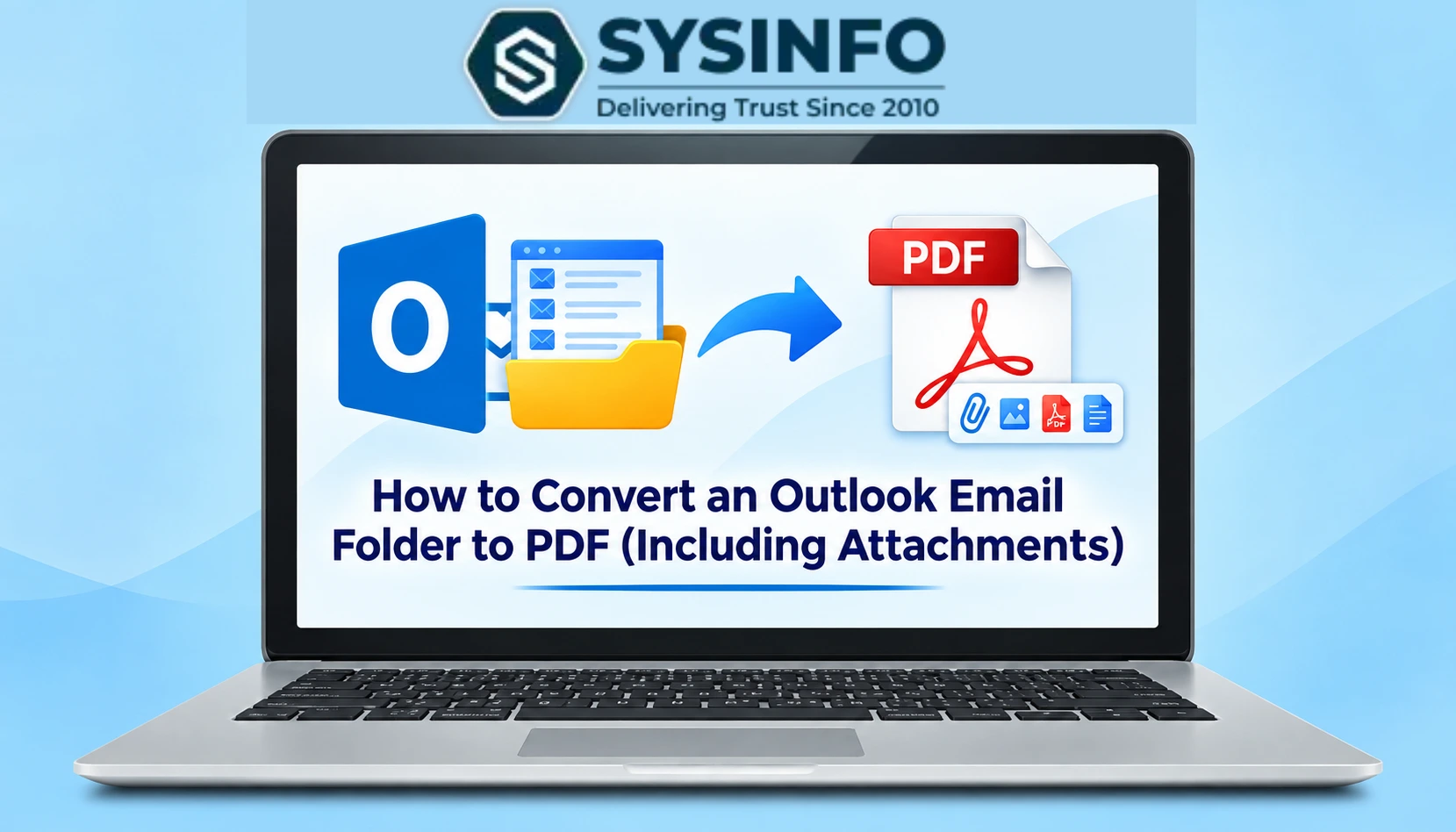
If the goal isn’t just cleaning the PST but to convert Outlook email folders to PDF for legal records, compliance archives, or client handovers, deduplication and conversion can happen in the same step.
SysInfoTools PST Converter converts PST contents to PDF while filtering duplicates during export. So the output document doesn’t contain the same email twice. Useful for legal teams packaging email evidence, compliance officers building audit archives, or IT administrators archiving a closed account before decommissioning. Its core capabilities include:
- Runs on Windows and Mac
- Supports all Outlook PST versions (2003–2024)
- Includes attachments in the PDF output
- Exports emails, calendar entries, and contacts; not just inbox
- Saves multiple emails into a single PDF or individual files per message
Moreover, the working of this software is simplified steps: Load Software→ Upload PST → Preview Emails → Select PDF Format → Apply Filters (Including Deduplicator) → Convert Files. Rest assured, you will have a satisfactory user experience with this software, built for all individuals and enterprises.
For Microsoft 365 Mailboxes: Post-Migration Duplicate Cleanup
Duplicate emails in a live M365 mailbox are a different problem from PST cleanup. The most common source is a tenant-to-tenant migration where emails were written twice. Once during initial migration and again during delta sync.
|
Microsoft Documents This Pattern: Items reappear or are duplicated in the archive mailbox after an archiving policy is enabled during IMAP migration |
SysInfoTools O365 Tenant to Tenant Migration handles the migration with deduplication built into the transfer process. Duplicates don’t arrive in the destination tenant in the first place, which is faster than post-migration cleanup. For organizations already past migration with duplicates in live mailboxes, the tool also supports post-migration mailbox remediation.
|
To better understand the cross-tenant post-migration duplicate removal process, refer to the Tenant to Tenant Deduplication Guide for all. |
Common Mistakes That Make the Problem Worse
- Running conversation clean up without setting exclusions: The defaults don’t protect flagged or categorized messages. Run it on a folder full of flagged items, and you’ll spend an hour recovering from Deleted Items.
- Importing PST without the deduplication option: The checkbox is on the import dialog but not pre-ticked. This is how most people double their mailbox.
- Emptying Deleted Items before reviewing Clean Up results: Conversation Clean Up sends to Deleted Items, not permanent deletion. Check before purging.
- Rebuilding OST for non-OST duplicates: Deleting and rebuilding the OST only fixes sync-artifact duplicates; the paired ones that vanish and reappear. If duplicates are real separate messages in a PST, rebuilding OST does nothing.
- Ignoring rules as a cause: If duplicates keep reappearing after cleanup, check rules first: File > Info > Manage Rules & Alerts. Look for conditions that could match the same message twice.
Duplicate Removal Decision Matrix
|
Your Situation |
Use This |
|
Redundant reply chains in one folder |
Conversation Clean Up (built-in) |
|
Duplicates by subject, single folder (<200 messages) |
Sort by Subject → manual delete |
|
Same-folder duplicates, Classic Outlook / Exchange only |
PST export/import with deduplication checkbox |
|
PST archive with duplicates across multiple folders |
SysInfoTools Outlook Duplicate Remover |
|
Mac user with PST file |
SysInfoTools Outlook Duplicate Remover (Mac + Win) |
|
Duplicate contacts, calendars, tasks in PST |
SysInfoTools Outlook Duplicate Remover |
|
Multiple PST files to merge and deduplicate |
SysInfoTools Outlook Duplicate Remover |
|
PST to PDF conversion with duplicates filtered out |
SysInfoTools PST Converter |
|
M365 mailbox duplicates from tenant migration |
SysInfoTools O365 Tenant to Tenant Migration |
|
Enterprise-scale, multiple mailboxes |
Dedicated tool — manual methods won’t scale |
|
Free trials available: SysInfoTools Outlook Duplicate Remover: Preview what will be removed before committing. SysInfoTools PST Converter: Verify PDF output quality on a limited batch before purchasing. |
Frequently Asked Questions
Q1. Does Outlook have a built-in duplicate email remover?
Ans. No. Conversation Clean Up removes redundant messages within conversation threads but won’t find standalone duplicate emails across folders. No Outlook version — including Microsoft 365 — has a native cross-folder duplicate finder.
Q2. How do I remove duplicates from multiple Outlook folders at once?
Ans. You can’t do it natively. Outlook’s Clean Up is folder-scoped, and the export trick doesn’t compare across folders. SysInfoTools Outlook Duplicate Remover scans the entire PST across all folders in one pass.
Q3. Does Conversation Clean Up work in New Outlook?
Ans. Partially. New Outlook has a simplified version. For full control over exclusion settings, use Classic Outlook.
Q4. Can I remove Outlook duplicates on a Mac?
Ans. Not reliably with native tools. SysInfoTools Outlook Duplicate Remover runs on Mac and handles PST files directly.
Q5. Why do duplicates keep coming back after I delete them?
Ans. Usually a rule delivering the same message twice, a sync issue, or multiple configurations of the same account. Fix the cause first, then clean existing duplicates — otherwise they regenerate.
Q6. Will removing duplicates modify my original PST file?
Ans. SysInfoTools Outlook Duplicate Remover creates a new clean PST file. The source is untouched until you verify the output and decide to replace it.
About The Author:
Simran Bhatia is a technical content writer engaged in writing clear, concise, and SEO-optimized content. With a background in computer science and a passion for writing, I thrive to deliver complex technical content in simple layman terms.
Related Post